
Frequent Questions
ARE YOU PASSIONATE ABOUT RENEWABLE ENERGY?
WOULD YOU LIKE TO REDUCE YOUR POWER BILL?
A grid-connected solar PV system may be for you. There are a few important things to consider:

What is a solar module?
Solar modules are generally flat panels mounted on roofs or other structures. Solar modules convert energy from sunlight into direct current (DC) electricity.
 |
 |
More energy is generated
|
Less energy is generated
|
What is a grid-connected solar PV system?
A grid-connected solar PV system is an array of photovoltaic modules connected via an inverter to provide power for your home, with excess production feeding into the grid.
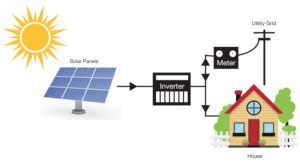
At night, when the solar modules are not producing electricity, the electricity comes to you from the grid. If you export enough energy during the day, it will balance or exceed the amount you draw from the grid at night.
What are the benefits of a solar PV system?
- Solar PV systems generate electricity
- Once the system has been purchased, electricity is generated from a “free” source – the sun
- Solar electricity is generated without emitting greenhouse gases
- Solar panels or modules are silent, without any moving parts
- Solar modules are generally unobtrusively mounted on an existing roof
- Solar modules can be integrated into the building in the form of windows, walls, roof tiles or pergolas
- Solar electricity can supplement or provide all your electrical consumption
- Solar electricity can be fed into the grid
- Additional solar modules can be added later as demand or budget grows
- A solar module should last for at least 20-30 years.
How do I choose the right system?
Factors to consider:
- your electricity demand – how much you use. The more electricity you demand, the larger the system and the greater the cost
- your budget – how much are you prepared to invest. Your budget may create limits on the size of the system
- your location – whether the mains electricity grid is available and, if so, how much would it cost to bring power out to your property and pay for ongoing maintenance of poles and cables on your property
- aspect – there needs to be sufficient space on your roof for the mounting of north-facing modules
- rebates – Commonwealth and/or state government rebates provide an incentive to householders to invest in solar. However, these are subject to change from time to time. The Clean Energy Regulator provides a free STC calculator to determine the number of STCs your project will create. Additionally, STC broker Greenbank have a calculator where you can see the current STC value based on live prices.
What size solar system do I need for my house?
There’s no easy answer to this question. Everyone’s electrical usage is different – it depends on:
- patterns of energy use in your household
- number of occupants
- types of appliances, gas or electric.
The size of the system will depend on:
- the physical un-shaded space available for the installation of your modules
- how much you are prepared to spend, and
- what portion of your electrical demand you wish to generate.
Can I increase the size of my system in the future?
This depends on your roof space and the size of the inverter. If you have sufficient roof space and additional capacity in the inverter you could increase the size of your system, or you could add a second system to your roof. Please note: At this time, the solar Feed-in Tariffs in each state have limits on the system size which to they apply. Increasing the size of an existing solar power system could affect your eligibility for a Feed-in Tariff.
Upgrades
Where the inverter capacity is larger than the capacity of the solar panels, you have the opportunity for a simple expansion to add more panels as you would like. If you have reached the maximum panels for your inverter size then you can upgrade the inverter to allow additional panels.
How do I check the performance of my solar system?
All of the modern inverters install have the ability to display information on how much power the system is producing. If your solar inverter is WiFi ready you can see your performance through web application on your mobile.
- The current Wattage and Voltage
This shows what the system is currently producing. The numbers will constantly wander up and down throughout the day as the environment changes. These numbers can be affected by the amount of UV, cloud cover and temperature and mostly give and indication that the system is turned on and functioning.
- Daily Production
Most systems will also display the total amount of power the system has produced during the current day. The best time to check this is just before your system shuts down in the evening as the number will reset overnight. The amount will vary depending on the weather and time of year.
- Total Lifetime Production
The inverter also keeps a record of all of the power the system has produced since the inverter was installed. This is the best indication of how the system is performing overall. The total will be displayed in either Kilowatt hours or Megawatt hours. 1000kWh is equal to 1 MWh.
Do solar panels work during blackout?
If your solar panel system is connected to the grid, it will shut off in the event of a blackout. This is to prevent emergency responders and electricity utility repair-people from being injured by your panels sending power back to the grid. However, there are certain inverters you can buy that provide backup power in a blackout when paired with a battery.
What is the ideal orientation for solar panels?
Solar modules produce most electricity when they are pointed directly at the sun. It is important to install them so that they receive maximum sunlight. Ideally they should be in full sun at least from 9 am to 3 pm. In Australia, solar modules should face north for optimum electricity production.
How long does an average installation take?
It’s hard to say about average installation time without knowing the size of solar power system. Bigger the system, longer the time it requires to be installed. Let’s take 5kW system for installation which takes around 3-5 hrs., start to finish.
Does weather effect on solar modules?
PV modules are placed in harsh conditions because they need sunlight to work. Up on the roof, it can be hot one minute, cold the next, not to mention rain, frost, and hail, you name it. But modern high-quality PV modules are very durable, and no matter what the weather throws at them they just keep generating.
How long will my solar panels last?
Good quality solar panels can be expected to last upwards of 20-25 years. If the quality of panels is particularly high (and they’ve been properly maintained), an installation can last up to 40 years.
Cleaning of your panels should be done at least once a year to ensure efficiency. However it only takes a couple of months for the dirt and grime to start building again.
Do solar power systems require maintenance?
We strongly recommend preventative maintenance being performed on all Solar Power Systems to ensure efficiency is maintained, correct operation and longevity of your system. As the panels are exposed to the elements, they will be collecting dust and contaminants that may not wash off with the rain. This build up means that your panels won’t work to the maximum efficiency that they do in their first year.
We provide this service :
- Clean all panels,
- Check system output
- Ensure the inverter, cabling, mounting, switches are secure and clean.
Solar panel maintenance and cleaning is not covered under panel warranties, but if your solar panels are damaged, they will usually be covered.
What does the product warranty cover on solar panels?
There are all sorts of different warranties to consider when it comes to comparing solar power systems and installation quotes. These include:
- Solar panel performance warranty (25 years)
- Solar panel product warranty (10 – 25 years)
- Inverter warranty (5 – 10 years)
- Installation (quality) warranty
- Entire system warranty
Solar panel performance warranty
Most solar panel warranties come with a 25-year performance warranty from the manufacturer. The performance warranty protects you against panels that degrade way faster than what they should. Most performance warranties guarantee that your panels will produce 80% of their rated output after 25 years. It is arguably the least important of all the warranties as it is difficult to prove that inferior performance is solely due to the solar panel module.
Solar panel product warranty
The solar panel product warranty provides you with protection should your system underperform due to faulty modules. The solar panel manufacturer provides the product warranty, and they normally guarantee the module for 10 – 15 years.
Performance vs product warranty
Tip: Don’t confuse the performance warranty with the product warranty, as this is one indicator that can separate better quality panels from lower grade modules. The product warranty guarantees that the product will continue working, while the performance warranty provides that the system will deliver a percentage of its rated output after 25 years.
Inverter warranty
The inverter warranty is as important as the product warranty because without a functioning inverter your panels won’t work anyway. The inverter also performs at high temperature and is the system component most likely to fail. Inverters typically come with a 5-year warranty, though in many cases you can pay more to have this extended.
Installation warranty
Your solar retailer will possibly offer you an install warranty that covers the solar panel installation. Installation warranties can vary from anywhere between 12 months to ten years.
“THE WARRANTY WITH US IS TEN YEARS”
What are STCs?
The solar panel rebate, or financial incentive (correct government term), is issued in the form of Small- scale Technology Certificates, commonly referred to as STCs. Each STC carries a monetary value that fluctuates between $34 – $40.
STCs are created upon installation of a Solar PV System with a solar panel capacity under 100kW. The number of STCs created is dependent on the solar system size and geographical location.
The created STCs can be sold in a live market which is used to reduce the cost of the installation to the home or business owner.
When does the government solar rebate end?
The Australian government solar panel rebate is scheduled to end in 2030. However, each year, the solar rebate reduces, so now is the best time to invest in solar power if you want to maximize your rebate savings.
Annual reduction in the solar rebate
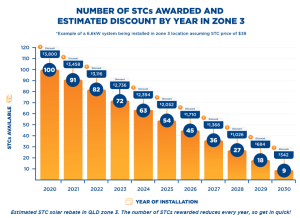
Currently, the calculation for your government solar rebate allows you to claim rebates on 10 years of operation. The number of years of operation will reduce by one each year up until 2030.
Here is an example of the STC solar rebate you could expect if you live in or around Brisbane, the Gold Coast, Cairns, Townsville, Rockhampton, Toowoomba or Mackay:
How is my rebate calculated?
The amount of STC’s you receive are affected by two main variables – Location & System Size.
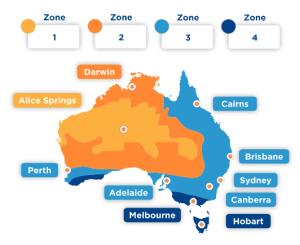
Instead of calculated the sun radiance in every postcode, Australia has been split into four zones with a different rating and multiplier the creation of STCs. The Federal Government splits all of Australia’s postcodes into 4 categories: Zone 1, Zone 2, Zone 3 and Zone 4.
What’s my solar rebate?
The Clean Energy Regulator provides a free STC calculator to determine the number of STCs your project will create. Additionally, STC broker Greenbank have a calculator where you can see the current STC value based on live prices.
How does the solar rebate work?
- Homeowners are entitled to a given number of STCs dependent on the system size, where the system is installed and which year the system is installed.
- The scheme can be claimed on multiple properties. The rebate is claimed by the installer of your system and passed on as a point of sale discount.
- STCs are a traded like shares and their worth fluctuates depending on the amount of installations occurring that year. More installs than expected and the worth depreciates. STCs are currently valued at around $37 but have been as low as $17, so now is definitely a good time to install.
What is battery storage?
Battery storage allows electricity generated by solar panels during the day to be stored for use when the sun has stopped shinning.
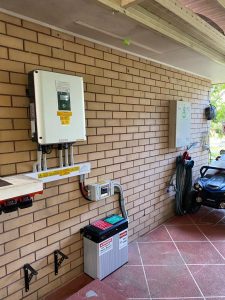 A battery storage system connects to a house in two main ways: DC (direct current) coupled or AC (alternating current) coupled. A DC-coupled battery storage system is integrated into the solar system. These systems generally have a single inverter that converts the DC electricity to AC to supply the house or feed back into the grid.
What are the benefits of batteries?
Installing a battery storage can provide a number of benefits when used in conjunction with a solar panel system. A battery storage system can:
- Help reduce reliance on the grid
- Maximize the energy used from solar panels by allowing it to be stored rather than sent to the grid
- Offset the increased cost of power used during peak times , such as during the evenings
- Save money by storing energy from the grid overnight when prices are low to use during peak times when prices are high (this will depend on the power agreement)
- Provide electricity during power outages (this will depend on the system).
How long do batteries last?
Product warranties on battery storage systems vary widely and are generally anywhere from two to 10 years. A battery storage system will often last longer than its warranty but its ability to store energy will gradually reduce over time with use.
Will the battery work in a blackout?
Not all battery storage systems provide backup power. Some will work during a blackout and some may operate following a brief power outage. If the battery storage system needs to work during a blackout, discuss it with the system designer and choose an appropriate product.
Is your installer CLEAN ENERGY COUNCIL-ACCREDITED?
To be eligible for government incentives, both the designer and installer of your solar PV system must be accredited by the Clean Energy Council. The Clean Energy Council’s accreditation ensures that those holding Accreditation:
- have undergone the necessary professional training.
- follow industry best practice
- must adhere to Australian Standards
- routinely update their skills and product knowledge.
It is also wise to:
- consider the recommendations of others who have purchased a similar system to the one you required
- engage someone with whom you’re happy to work, and
- look for designing and installing experience in the industry, not just a retail outlet.
Inverter Brands We Carry…